I Have Always Wondered Why
I have always been fascinated by languages.
Not because I wanted to become fluent in all of them.
Because every language seems to carry the personality of the people who speak it.
Sometimes it isn’t even the words themselves.
It’s the pauses.
The expressions.
The rhythm.
The way silence is used.
The way people disagree.
The way affection is expressed.
Even when two countries speak the same language, they often sound as though they are describing two different worlds.
One language rushes.
Another wanders.
One fills every silence.
Another allows silence to remain.
Then there are places where history itself seems to live inside the language.
Where one language didn’t replace another.
It stayed.
It blended.
It left fingerprints.
New expressions appeared.
Old words survived.
The grammar bent a little.
The accent carried memories that dictionaries never could.
I find that beautiful.
The more I listened, the more I realized I wasn’t really interested in languages.
I was interested in the people who created them.
Why does one culture value directness while another values diplomacy?
Why does the same gesture mean kindness in one place and distance in another?
Why does one society protect feelings with words while another believes respect begins with honesty?
Perhaps words don’t carry meaning by themselves.
Cultures decide what those words mean.
The same expression can sound warm in one country and patronizing in another.
The same silence can feel respectful to one person and uncomfortable to another.
The words didn’t change.
Only the history behind them did.
The more I learned about different cultures, the more I realized I wasn’t only learning about them.
I was learning about myself.
Some customs felt unfamiliar.
Others felt strangely familiar.
Sometimes I found myself thinking,
“So that’s why this has always made sense to me.”
It was as though another culture gave a name to something I had always carried but had never known how to describe.
Then I realized something else.
I wasn’t really studying cultures.
I was studying origins.
Not the history of kings or governments.
The history that lives inside ordinary people.
What happened to this people that made them become this way?
What happened to this family?
What happened to this person?
When someone is quiet, I wonder what made silence feel safer.
When someone speaks with remarkable honesty, I wonder what taught them that clarity mattered more than diplomacy.
When a people sing through suffering, I wonder how music became part of survival.
When another tells stories that wander before reaching the point, I wonder what history taught them that the journey mattered as much as the destination.
Every person carries a history.
Every family carries one.
Every culture carries one.
Sometimes it is written in books.
Sometimes it survives only in songs.
Sometimes it hides inside an accent.
Sometimes it lives inside an old expression that has outlived the people who first spoke it.
The more I understand those histories, the less interested I become in judging people.
Because once you begin asking,
“What happened here?”
instead of,
“What’s wrong with them?”
the world becomes a very different place.
I have met people whose lives took opposite directions even though they came from the same family.
I have listened to old men tell stories that everyone else dismissed.
I have read histories that suddenly made an entire culture make sense.
Every time, I walk away with the same realization.
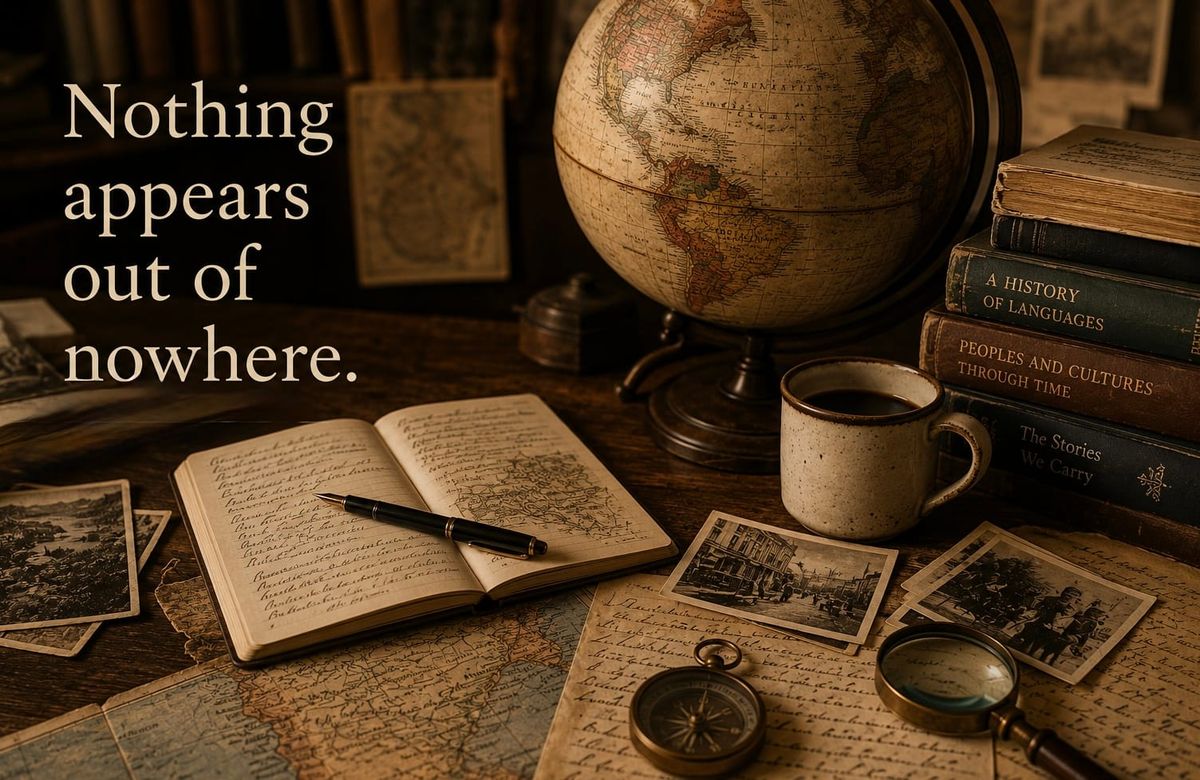
Nothing appears out of nowhere.
Not a language.
Not a culture.
Not a person.
They are all shaped.
By love.
By loss.
By geography.
By migration.
By hardship.
By hope.
By the stories they refuse to forget.
Perhaps that is why I have always preferred listening over assuming.
Because every person I have ever taken the time to understand has turned out to be far more interesting than my first impression.
I have never really been searching for places.
Or languages.
Or even cultures.
I have been searching for origins.
Because somewhere inside every person, every family, and every culture is the answer to the same question.
How did you become you?