The Language We Never Outgrew
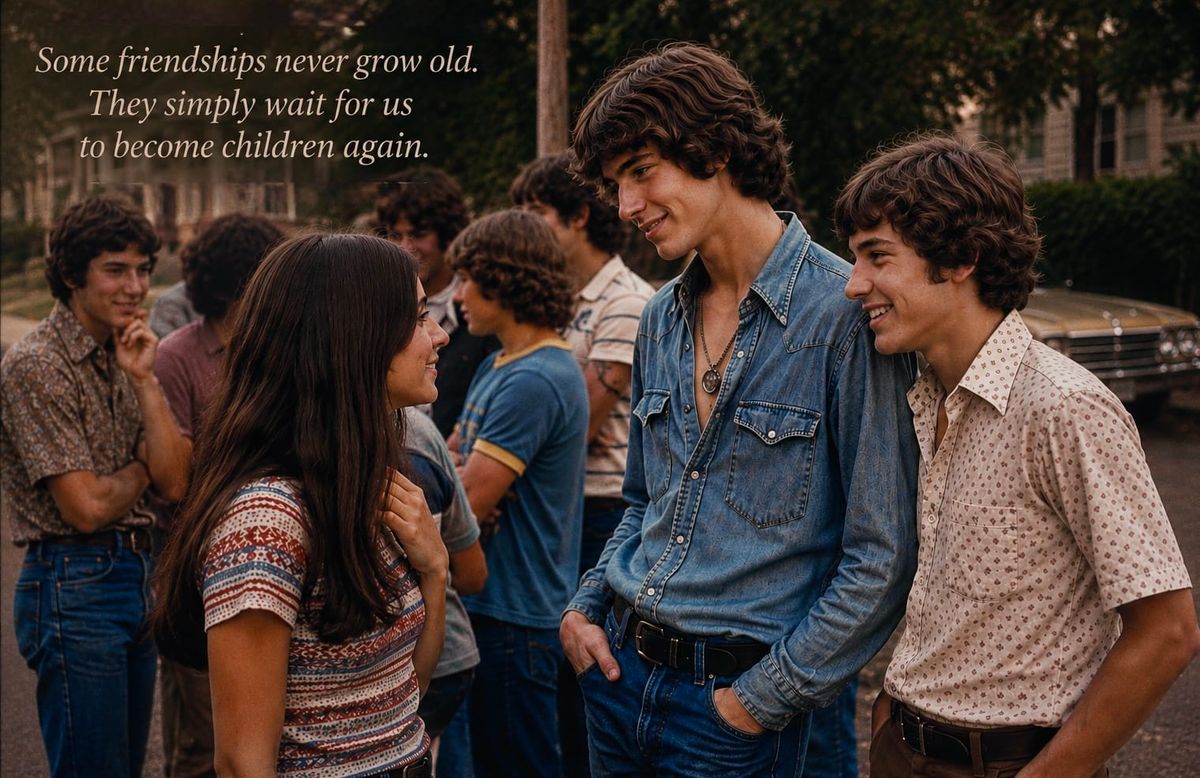
I grew up surrounded by boys.
Not because I had brothers, but because our neighborhood worked differently back then.
The boys who lived nearby were in and out of our house almost every day. By lunchtime someone was asking my mother what was for dinner. By afternoon they were borrowing bicycles, kicking footballs, climbing trees, or inventing another reason not to go home just yet.
We didn’t need invitations.
We simply belonged to each other’s childhood.
I was ten years old when I developed the biggest crush on one of them.
His younger brother found this completely unacceptable.
According to him, I had chosen the wrong brother.
He insisted he was far better looking.
I disagreed.
That became our joke.
Some arguments never really end.
Eventually, childhood did what childhood always does.
School ended.
One by one we left.
Some went to university.
Others found jobs.
Life scattered us in different directions until the little neighborhood where we had spent every afternoon together became nothing more than a collection of memories.
Decades passed.
Then one day, quite unexpectedly, one of those memories wrote to me.
We were living on different continents.
We had built different lives.
We both had families, responsibilities, careers, and entirely separate worlds.
And yet, within minutes of talking…
…we were ten years old again.
Not immature.
Not irresponsible.
Simply ten.
He still insisted I had chosen the wrong brother.
I still laughed every single time.
We invented silly little sentences with double meanings that only we understood—not because they were secrets, but because they belonged to a childhood nobody else had shared.
It was never about hiding.
It was about remembering.
Children do this naturally.
They invent languages.
Nicknames.
Codes.
Entire worlds built from ordinary words.
Then they grow up.
Or perhaps the world simply forgets how children speak.
One day I realized something I had never considered before.
The same conversation can tell two completely different stories depending on who is reading it.
To us, we were simply continuing a conversation that had begun decades earlier.
To someone else…
…it looked like something entirely different.
How do you explain forty years of shared memories to someone who wasn’t there for the first one?
You can’t.
So I quietly stepped away.
Not because the friendship had changed.
But because the way it was seen had.
What stayed with me wasn’t the misunderstanding.
It was the realization that adulthood sometimes demands explanations that childhood never needed.
We had even begun making plans.
Not extraordinary ones.
Just the ordinary kind.
Meeting again.
Introducing our families.
Watching our children discover that once upon a time their parents had been children too.
I thought there would be time.
There wasn’t.
He left this world before we ever had the chance.
And every now and then I still catch myself smiling at the same ridiculous thought.
Somewhere, if he can hear me, he’s probably still insisting he was the better-looking brother.
I still disagree.
And perhaps that’s the language we never outgrew.