When Did We Stop Courting Through Language?
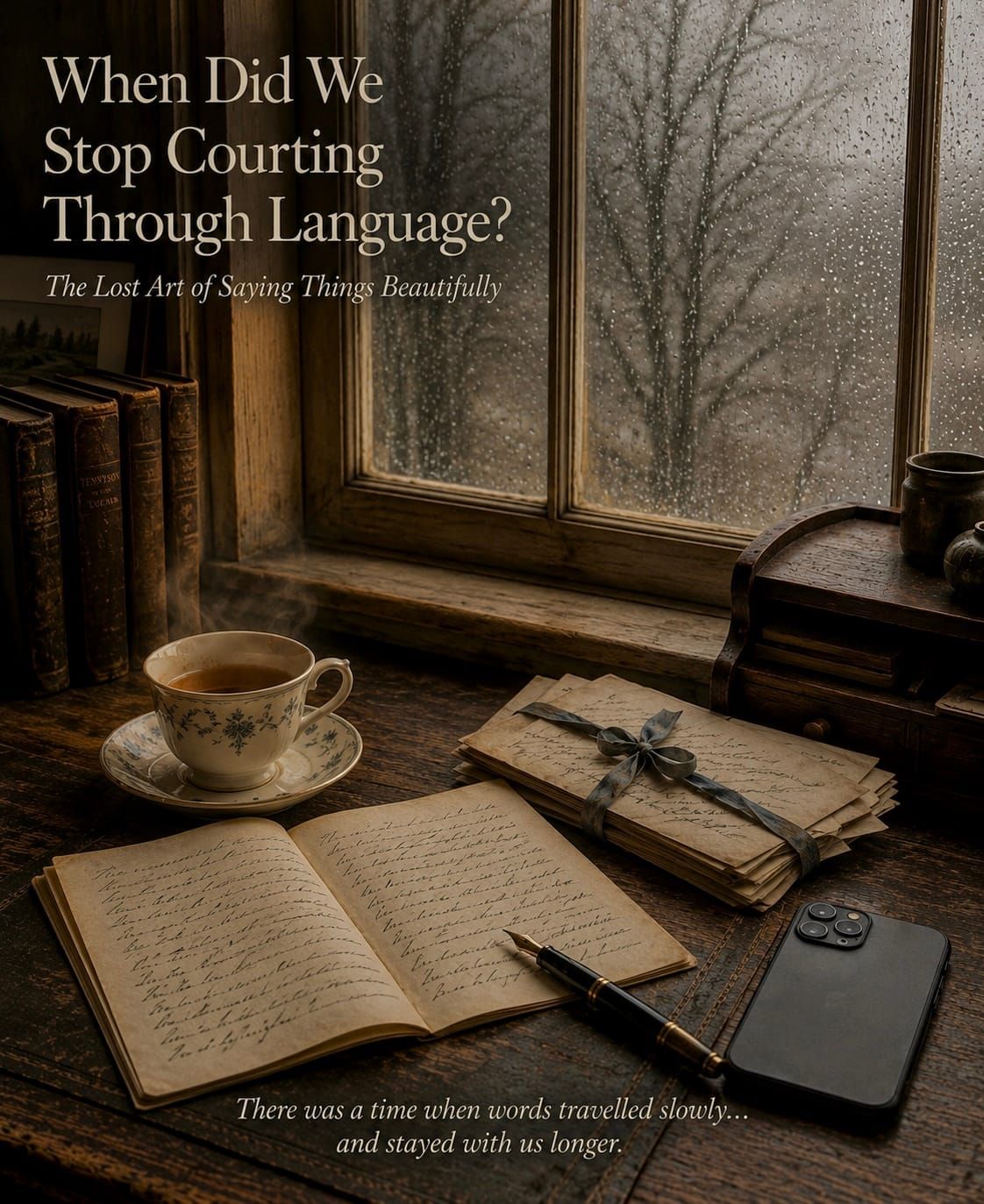
The Lost Art of Saying Things Beautifully
Quite by accident, I found myself wandering through letters written in another age.
Not because I had been searching for them.
Not because I wished to exchange electricity for candlelight, although I confess the thought possesses a certain quiet charm.
I was searching for nothing at all.
Yet somewhere between faded ink, folded paper, and words that had patiently crossed oceans before finding the hands for which they had been intended, I discovered something I had not realised I had been missing.
It was not the vocabulary.
It was not the grammar.
It was not even the elegance.
It was the unmistakable feeling that every sentence had been written as though another human being truly mattered.
There was no haste.
No urgency to arrive at the conclusion before the journey had been enjoyed.
A letter was not simply read.
It was unfolded.
One page at a time.
One thought at a time.
One carefully chosen sentence following another, each entrusted with carrying not merely information, but presence.
Writing was never treated as the shortest distance between two thoughts.
It was an invitation to linger.
To observe.
To smile.
To imagine.
To participate.
A gentleman seldom declared,
“I miss you.”
Instead, he confessed that the hours had acquired an unfortunate habit of lingering in her absence.
Nothing more had been communicated.
Yet somehow, everything had.
The sentence did not merely inform.
It invited.
It asked the reader to walk beside it for a while before quietly revealing where it had been going all along.
That, I realised, was the extraordinary difference.
Language once involved us.
Today it often delivers instructions.
We no longer write,
“I trust this letter finds you in good health and in even better spirits.”
We write,
“Hope you’re good.”
We no longer write,
“I look forward to seeing you this afternoon, and I hope the day has been kind to you before then.”
We write,
“See you at three.”
None of these sentences are wrong.
But they do not carry the same weight.
One reaches for the person.
The other reaches for the point.
One pauses long enough to acknowledge that another human being has lived an entire day before receiving those words.
Perhaps they have laughed.
Perhaps they have worried.
Perhaps they have received wonderful news.
Perhaps they are tired in a way they have not yet admitted aloud.
Or perhaps their heart is quietly breaking.
The older sentence leaves room for all of it.
The newer one simply assumes the appointment still stands.
And perhaps that is the change I find myself mourning.
Not the passing of horse-drawn carriages.
Not elaborate manners.
Not impossibly long letters.
I miss the belief that ordinary things deserved to be said beautifully.
A greeting.
A farewell.
A thank you.
A compliment.
A wish for peaceful sleep.
Even affection itself once seemed unwilling to arrive without first putting on its Sunday clothes.
Somewhere along the way, we convinced ourselves that efficiency was the highest virtue language could possess.
Messages became shorter.
Replies became quicker.
Thoughts became compressed until entire conversations were reduced to a handful of hurried words.
Communication survived.
Conversation quietly surrendered something of its soul.
I recently came across a wonderfully sarcastic remark about receiving a message consisting of a single letter:
“K.”
The response read something like this:
“I’ve already called for help. You must have suffered a stroke while typing. Your poor weakened fingers managed only the letter K before collapsing. Stay where you are. Assistance is on its way.”
It made me laugh.
Not because the reply was cruel.
Because it exposed, with remarkable humour, what many of us had already begun to notice.
We had become astonishingly efficient.
Yet somewhere between speed and convenience, we had quietly stopped delighting one another with words.
Perhaps that is why I found myself so captivated by Victorian correspondence, wartime love letters, and even the ingenious little codes couples invented when military censors stood between them and the people they loved.
HOLLAND.
ITALY.
Entire declarations of affection hidden inside ordinary language, not because they wished to be clever, but because love refused to surrender its poetry, even to war.
And I could not help wondering whether the true purpose of language was ever simply to be understood.
Perhaps it was also meant to leave another human being smiling after we had gone.
Perhaps beautiful language was never an ornament.
Perhaps it was always an act of generosity.
A quiet way of saying,
“You were worth my very best words.”