The Mind of a Scammer
We all know about scammers.
Most of us know someone who has been scammed, almost scammed, or at least received a message that made something inside us say, No. Something isn’t right.
We delete it. Block the person. Maybe report the account. Then we continue with our lives.
There are thousands of warnings telling us what to look for. Don’t send money. Don’t buy gift cards. Reverse-search photographs. Be suspicious of sudden emergencies. Be careful when someone you’ve never met becomes emotionally attached too quickly.
But this isn’t another warning about scammers.
I’m interested in the scammer.
We spend enormous amounts of time studying the victim.
Why did she believe him?
Why did he send the money?
How could they not see the red flags?
For once, turn the camera around.
Who is sitting on the other side of that screen?
We all have jobs. We all need money. Many people have worked for companies whose practices they didn’t particularly admire. Maybe one morning you discover that the corporation signing your paycheck is polluting a lake, mistreating workers or doing something fundamentally incompatible with your values.
Some people stay because the mortgage still arrives every month.
Some rationalize it.
Some eventually decide they cannot participate anymore and leave.
Human beings have always been remarkably good at negotiating with their consciences when survival, comfort or money is involved.
But scamming requires something different.
The victim isn’t incidental to the income. The victim is the income.
Think about the work involved.
You don’t simply invent a lie.
You invent a person—and then go to work as him.
You need a name. An age. A photograph. A profession. Perhaps a city. A childhood. A former marriage. Maybe a dead spouse. Children. Hobbies. Favorite music. Places you’ve traveled. Things you supposedly want to do before you die.
Then you have to remember all of it.
But that’s only half the job.
You also have to remember the person you’re deceiving.
Her children. His divorce. Her favorite place in Italy. His mother’s illness. Her birthday. The dog that died three years ago. The conversation you had last Tuesday about getting older.
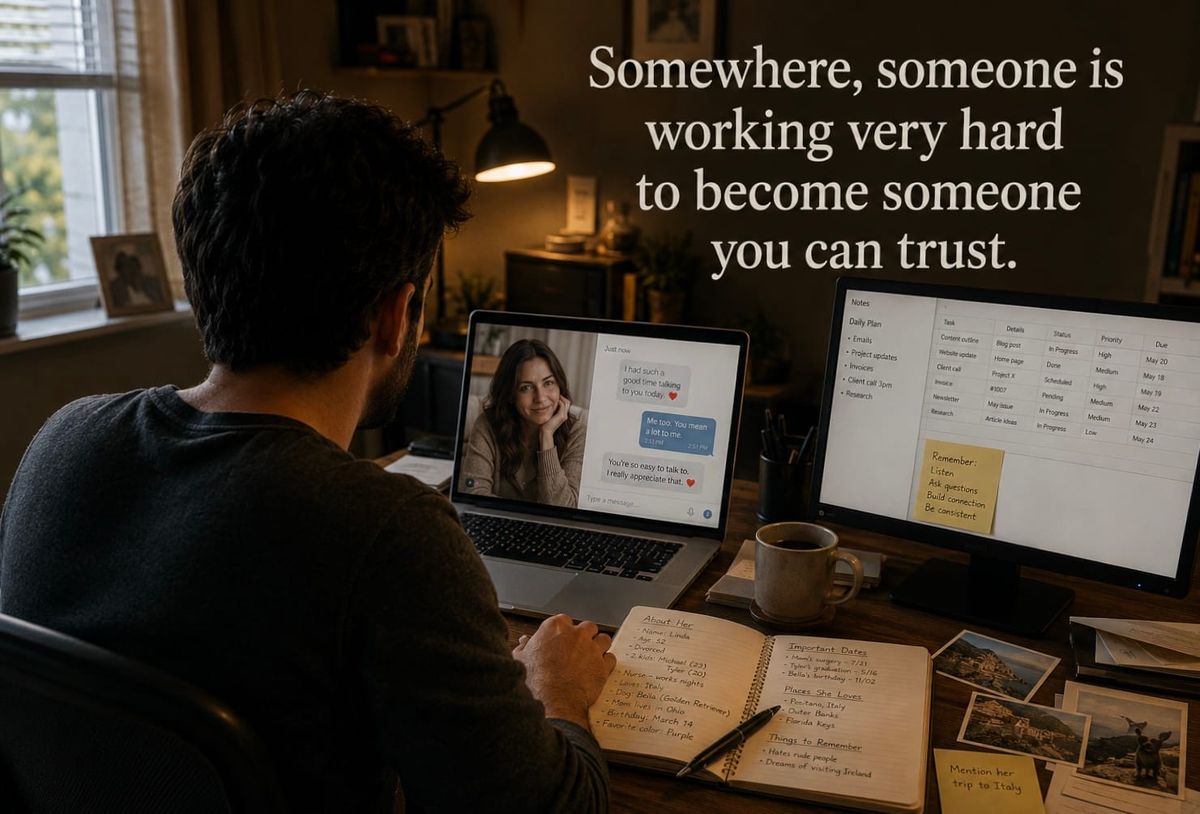
Do they keep notebooks?
Apparently, sometimes they do.
Investigators have found scammers keeping records about their victims because maintaining deception requires information. And in larger operations, the person speaking to the victim may not even be the person who ultimately receives or moves the money.
There can be different jobs.
Different people.
Different pieces of the same lie.
One creates trust.
Another handles money.
Another moves it.
Someone may never speak to the victim at all.
That fragmentation fascinates me because it also provides convenient places for conscience to hide.
I didn’t steal her money. I only talked to her.
I never lied to anybody. I only transferred the money.
I don’t know these people. I just provide the accounts.
Everybody performs his small part.
And somewhere at the end of the machine is a real person who believed another human being cared about her.
What kind of environment can make deceiving another human being feel like ordinary work?
Because nobody wakes up one Tuesday morning psychologically prepared to spend three months impersonating a widower to steal someone’s savings.
Somewhere between I would never do that and this is what I do for a living, something happened.
Maybe it begins with necessity.
Maybe greed.
Maybe somebody introduces you to someone making considerably more money than you are.
Maybe everyone around you is doing it.
Maybe after enough time the people on the screen stop looking like people.
Americans have money.
Europeans have money.
They’ll recover.
Maybe eventually it’s simply a job.
And I wonder what happens after enough repetition.
Does the guilt disappear?
Does success become exciting?
Do scammers compare victims?
Do they congratulate one another when someone finally sends the money?
Does a person who has spent six weeks pretending to care about someone ever accidentally begin to care?
Has a scammer ever reached the moment when the plan finally worked—the victim was ready to send the money—and thought:
Not this one.
I don’t know.
That’s precisely why the mind behind the scam interests me more than another list of red flags.
Imagine this as a job advertisement.
Work from home.
No commute.
No inventory.
Minimal overhead.
Create a personality.
Find someone vulnerable.
Make them believe you care.
Earn a few thousand dollars.
Great business.
Except your product is trust.
And now imagine actually doing the job.
Every morning you become someone else.
You have to remember who you are today.
The invented profession. The invented childhood. The invented wife. The daughter who may not exist. The project you’re supposedly working on. The music you said you loved three weeks ago.
Maybe there’s a notebook beside the computer.
Maybe a spreadsheet.
Maybe carefully organized files containing pieces of real people’s lives that you need in order to maintain your imaginary one.
What happens when you forget the notebook?
What happens when someone unexpectedly wants to talk in real time?
When there isn’t enough time to check what you said three weeks ago?
Did I tell her I had one daughter or two?
Was my wife dead five years or seven?
Did I tell this woman I worked offshore, or was that someone else?
And then there is the possibility that must occasionally appear in the back of the mind:
She knows.
One photograph searched.
One inconsistency noticed.
One question you answered incorrectly.
One person on the other side of the screen suddenly thinking:
Something isn’t right.
Every time we learn how to recognize the lie, the lie has to learn how to look more like the truth.
So the photographs improve.
The stories improve.
The conversations last longer.
Technology improves.
And the invented person becomes increasingly difficult to distinguish from a real one.
Which brings me to the Internet itself.
When it arrived, I thought it would bring us closer.
Knowledge without borders. Conversations across oceans. People who would never have crossed paths suddenly able to exchange ideas, stories, photographs, languages and pieces of completely different lives.
It would make us more connected. More productive. More engaged with a world much larger than the one outside our own front door.
And it did.
But we are human.
Give us something extraordinary and, eventually, someone will figure out how to exploit it.
We created a way for two strangers thousands of miles apart to sit in their homes and get to know each other.
And someone looked at that miracle and thought:
I can make money from this.
Not by selling something.
Not by creating something.
By becoming someone.
By manufacturing affection. By studying loneliness. By turning attention into strategy, trust into inventory and human connection into a transaction.
Maybe that is the part I find hardest to understand.
We built a technology capable of bringing almost anyone in the world into our lives.
And then we had to learn to ask whether the person who arrived was ever there at all.