We Keep Watching the Finished Product and Forgetting There Was a Factory
I have been watching people move abroad lately.
Some sell their houses. Some quit their jobs. Some pack everything into a few suitcases and get on a plane. Others announce that their visa was approved, show us the apartment they found, take us grocery shopping in their new neighborhood, and introduce us to the life they have finally created.
Twenty minutes later, they’re living in the UK, Albania, the Netherlands, Italy, Spain, or somewhere else entirely.
And there I am thinking:
Well, that looked easy.
Except it wasn’t.
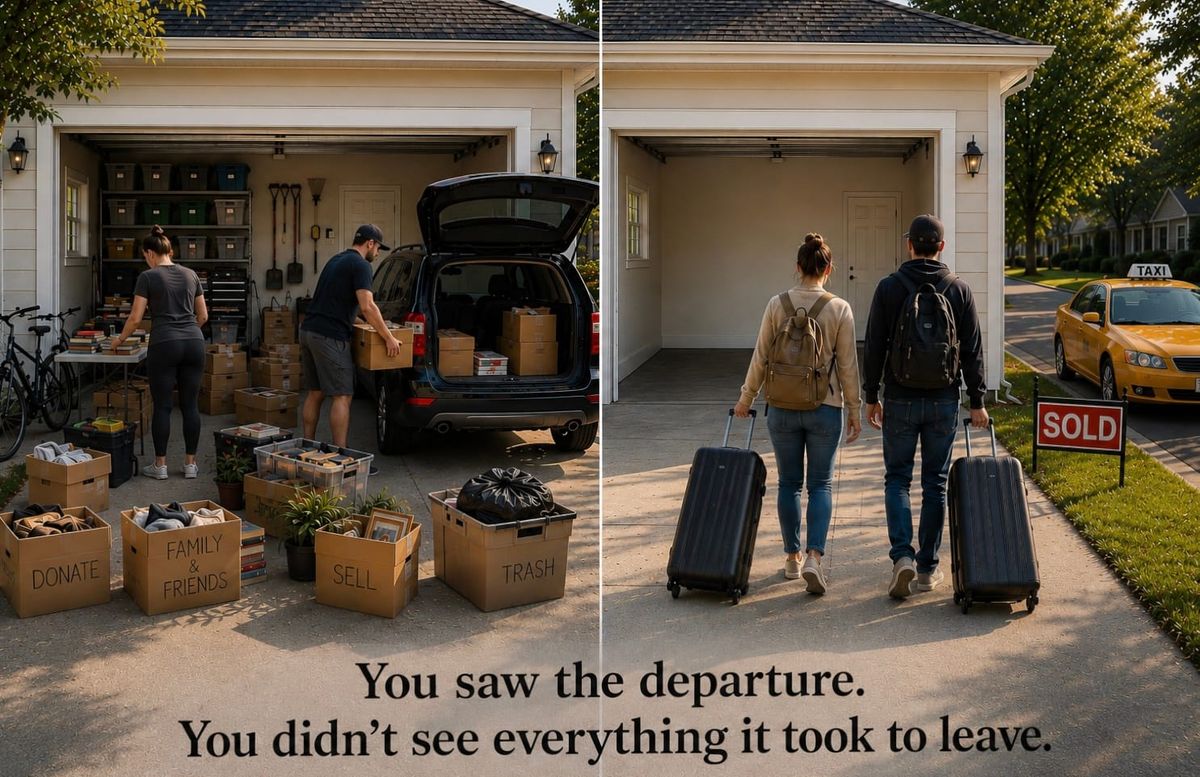
We just didn’t live the two years that came before the twenty-minute video.
We didn’t see every piece of paperwork spread across the kitchen table.
We didn’t see the document that was returned because it needed to be translated.
We didn’t see the appointment that took months to get, the email that wasn’t answered, the requirement they misunderstood, the application they had to correct, or the night they sat awake wondering whether they had made a terrible mistake.
We see:
We decided to move abroad.
Then:
Our visa was approved!
What happened between those two moments?
Sometimes, an entire life.
Recently I found a couple whose story caught my attention immediately.
“We decided to quit our jobs and become homeless,” they said.
Then came the important part:
“It was our choice.”
They had been preparing for more than two years.
They talked about getting rid of their belongings, changing the way they spent money, preparing to live in a much smaller space, and learning to question every new purchase.
Suddenly buying something isn’t simply:
Do I like this?
It becomes:
Do I like this enough to pack it, move it, pay to transport it, find space for it, and possibly have to get rid of it later?
That isn’t the glamorous part of moving abroad.
But perhaps it is the most important part.
I would actually love to find a channel that begins before the decision has even been made.
Someone turning on the camera and saying:
Hey, I think I want to move abroad. I have no idea where. Let’s figure this out.
Then show me the countries.
Show me the pros and cons.
Show me the budget.
Show me the visa requirements.
Show me the country that looked perfect until you discovered something that made it impossible.
Show me when you changed your mind.
Show me when you thought you couldn’t afford it.
Show me the spreadsheet.
Show me the argument.
Show me the doubt.
Show me a day when nothing happens.
Because that is the part we rarely see.
We usually meet people after they know the ending.
And once you know the ending, the story becomes much easier to tell.
The same thing happens everywhere.
Someone loses fifty pounds and shows us the before-and-after photographs.
Someone builds a successful business and tells us how they started.
Someone publishes a book and holds the finished copy in front of the camera.
Someone renovates an abandoned house and gives us a beautiful tour.
Someone moves across the world and films the sunset from the balcony of the apartment they finally found.
We see the result.
We don’t see the factory.
And perhaps that is why it becomes so easy to look at somebody else’s life and think:
I can do that.
Maybe you can.
But their twenty-minute video isn’t the instruction manual.
Their circumstances aren’t yours.
Their money isn’t yours.
Their health isn’t yours.
Their passport isn’t yours.
Their responsibilities aren’t yours.
Their tolerance for uncertainty isn’t yours.
Their luck isn’t yours.
Even their optimism isn’t yours.
Someone else’s life can show us that something is possible.
It cannot tell us what it will cost us to make it possible.
I recently watched a family who had spent ten weeks traveling in Europe. They returned home knowing that they wanted to build a life abroad and are now considering Germany or Spain.
That’s the beautiful part of the story.
The difficult part came afterward.
Wanting to live somewhere and having the financial and legal means to live there are two completely different things.
Now comes the work.
The money.
The visa.
The planning.
The backup plan.
The waiting.
The reality.
Especially when children are involved, the dream cannot be the entire plan.
And none of this means we shouldn’t dream.
Quite the opposite.
Sometimes watching someone else do something gives us permission to imagine a possibility we had never considered for ourselves.
But inspiration and replication are not the same thing.
Someone else’s success can show us that a door exists.
It doesn’t mean we have their key.
Maybe we need to make our own.
And this isn’t only about moving abroad.
Think about something as insignificant as watching someone make cookies.
The kitchen is immaculate.
Every ingredient is measured into a beautiful little bowl.
The butter is the perfect temperature.
The dough behaves.
Every cookie comes out of the oven golden, round and identical.
Eight minutes.
Perfect cookies.
What we don’t know is whether three batches went into the trash before the camera ever showed us the one that worked.
Because nobody uploads:
Batch Number Four: Still Terrible.
We upload the cookies that worked.
We photograph the room after we cleaned it.
We announce the visa after it was approved.
We show the body after it changed.
We tell the story once we understand what the story was.
There is nothing necessarily dishonest about that.
It is simply what editing does.
It removes waiting.
It removes repetition.
It removes mistakes.
It removes the boring parts.
It turns months into minutes and years into paragraphs.
And that is wonderful for storytelling.
It can be terrible for comparison.
Because life doesn’t have an editing room.
When we are the ones living through the process, we cannot fast-forward through the uncertainty.
We don’t know which batch of cookies will finally work.
We don’t know whether the application will be approved.
We don’t know whether the business will succeed.
We don’t know whether the country we dreamed about will feel like home once we actually live there.
We don’t know the ending.
We have to live the factory.
Maybe that is what we should remember the next time someone’s beautiful finished life appears on our screen.
Enjoy it.
Learn from it.
Let it inspire you.
Let it show you possibilities.
But don’t confuse their finished product with your starting point.
And if you decide you want something similar, turn off the video eventually.
Because watching someone organize, declutter, donate their belongings and create a life with more freedom won’t make our own closets any emptier.
At some point, we have to open the closet.
At some point, we have to decide what stays and what goes.
At some point, we have to make the bad batch of cookies.
At some point, we have to fill out the paperwork.
At some point, we have to live the part nobody edited for us.
The finished product may take twenty minutes to watch.
The factory could take years.